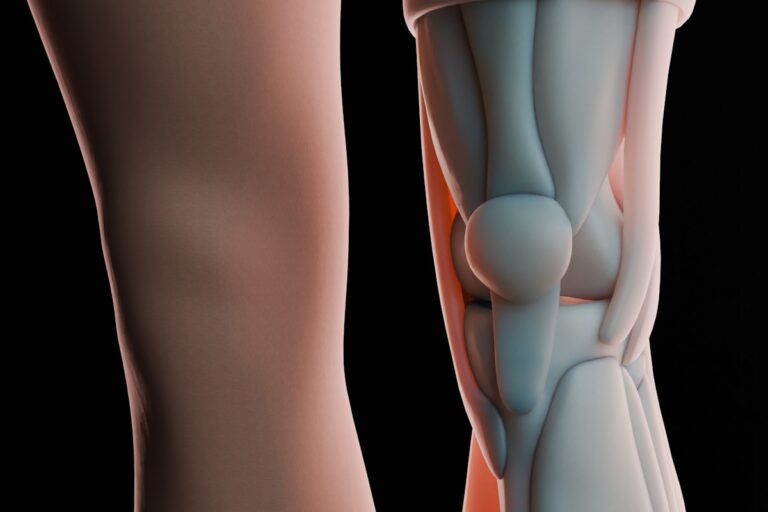
Quick answer: A lump behind the knee is most often a Baker’s cyst, which is a pouch of joint fluid that collects in the hollow at the back of the knee. It is not the only possibility. The same swelling can also be a ganglion cyst, a lipoma, a swollen lymph node, a blood clot in a deep vein, or an enlarged artery, and two of those are medical emergencies. The practical rule is simple. A soft, squishy swelling that comes and goes with knee pain is usually a cyst. A lump that pulses, a calf that is hot, red and tight, a hard lump that keeps growing, or a fever alongside the swelling all need same-day medical attention, not a wait-and-see week.
What is the most likely cause of a lump behind the knee?
Most health sites answer this question the same way, and for the majority of people they are right: the most common fluid-filled swelling in the popliteal fossa, the shallow hollow at the back of the knee, is a Baker’s cyst, also called a popliteal cyst. It forms between the semimembranosus tendon and the inner head of the calf muscle, and it is most common in adults between roughly 35 and 70 years old, according to the National Library of Medicine’s StatPearls review of Baker’s cyst.
Here is the part that answer usually leaves out, and it is the part that changes what we actually do in the clinic. A Baker’s cyst is rarely the real problem. It is a signal. Joint fluid only collects behind the knee because something inside the joint is producing too much of it, most often knee osteoarthritis or a degenerative meniscus tear. Treating the bulge and ignoring the cause is why so many people tell us their cyst drained and then came back within months. The other thing that answer leaves out is that the published differential list for a lump behind the knee includes deep vein thrombosis and popliteal artery aneurysm. That is the reason no responsible clinic, ours included, will tell you what your lump is over the phone.
Near Riverdale, GA?
We treat knees, shoulders, hips and backs without surgery at one clinic on Upper Riverdale Road. Send the form or call and our team will confirm your visit.
483 Upper Riverdale Road SW, Suite F, Riverdale, GA 30274. Most major insurance and Medicare accepted. PRP is typically elective and not covered by most plans, and our team can walk you through payment plans through Pathways.
What else can cause a lump behind the knee?
The StatPearls differential list for a mass in this location covers a wide range: abscess, arteriovenous fistula, deep venous thrombosis, ganglion cyst, hemangioma, hematoma, lipoma, swollen lymph nodes, and rarely a malignancy such as a fibrosarcoma or liposarcoma. In everyday practice, a lump behind the knee usually turns out to be one of the following.
A Baker’s cyst. Soft, sometimes squishy, often more obvious when you straighten the leg and softer when you bend it to about 45 degrees. It frequently comes with the stiffness, grinding or swelling of an arthritic knee, and it tends to wax and wane with how active you have been. Our full write-up on non-surgical Baker’s cyst treatment covers how these are managed once one is confirmed.
A ganglion cyst. Firmer and more rubbery than a Baker’s cyst, often smaller, and it arises from a tendon sheath or the joint capsule rather than from the knee joint space itself. It usually does not fluctuate with knee activity the way a Baker’s cyst does.
A lipoma. A benign lump of fat under the skin. It feels soft and doughy, moves easily under your fingers, is usually painless, and grows very slowly over years rather than weeks.
A swollen lymph node. The popliteal lymph nodes sit deep behind the knee and can enlarge in response to an infection anywhere below the knee, including an infected cut on the foot or a case of cellulitis in the lower leg. These are often tender and usually come with another sign of infection.
A blood clot in a deep vein. Deep vein thrombosis does not usually present as a discrete lump you can pinch, but it does cause swelling, tightness, warmth and often a dull ache in the calf, and people commonly describe it as a lump or fullness behind the knee. This is the diagnosis that cannot wait.
A popliteal artery aneurysm. An enlarged, weakened section of the artery that runs through the back of the knee. It is uncommon, but it is the reason a clinician will place fingers on the lump and check whether it pulses. A pulsating lump behind the knee is treated as vascular until proven otherwise.
A hematoma or a muscle injury. A collection of blood after a fall, a direct blow or a torn calf muscle can feel like a firm lump behind the knee for a week or two before it settles.
Which symptoms mean a lump behind the knee needs urgent care?
Most people with a lump behind the knee are fine to book a routine evaluation. A short list of findings changes that, and they are worth knowing by heart.
- The lump pulses under your fingers. This raises the question of a popliteal artery aneurysm and should be checked the same day.
- Your calf is swollen, warm, red or unusually tight, especially after surgery, a long flight, a long drive or a period of bed rest. These are the classic signs of a deep vein thrombosis, and a ruptured Baker’s cyst can look almost identical, which is precisely why it needs a professional to tell them apart rather than an internet search.
- You have a fever, chills, or the skin over the lump is hot and angry. Infection in or around a joint is time-sensitive.
- The lump is hard, fixed in place, painless and steadily getting bigger. Most lumps behind the knee are benign, but a mass with this pattern needs imaging rather than reassurance.
- You suddenly cannot put weight on the leg, or the knee locks or gives way.
If any of those apply, go to an emergency room or an urgent care center now. Do not wait for an appointment with us, and here is a specific reason why. Our Riverdale clinic is open Monday through Wednesday from 9:00 AM to 5:00 PM and Thursday from 9:00 AM to 3:00 PM, and we are closed Friday, Saturday and Sunday. If you notice a hot, tight calf on a Thursday afternoon, the next time you could be seen here is the following Monday, and that is far too long to sit on a possible clot. We would rather you were assessed somewhere else that same day and then came to us afterwards for the knee itself.

How do doctors tell a lump behind the knee apart from a clot?
The work starts with your history and a hands-on examination, and a surprising amount can be sorted out there. A clinician will ask how long the lump has been present, whether it changes size, what it feels like when you bend and straighten the knee, and whether you have had a knee injury, a recent infection or a recent period of immobility. One classic maneuver, Foucher’s sign, involves feeling the lump while the knee moves between full extension and about 45 degrees of flexion. A Baker’s cyst characteristically softens as the knee bends.
When the examination does not settle the question, imaging does. StatPearls describes the usual sequence as plain radiography and ultrasonography first, followed by MRI, particularly when surgery is being considered. Ultrasound earns its place at the front of that queue for a practical reason: it shows whether a lump behind the knee is filled with fluid or is solid, and colour duplex ultrasound also shows blood flow, which is how a pulsating mass is separated from a cyst. If a clot is genuinely suspected, ultrasound of the leg veins is the standard test and it happens urgently rather than as part of a routine knee work-up.
What happens at a Riverdale evaluation for a lump behind the knee?
Regenerative Joint Clinics is a non-surgical joint pain practice at 483 Upper Riverdale Road SW, Suite F, in Riverdale, GA. A few things about how we run are worth saying plainly before you book, because they are the questions people ask us most.
We see you in person. There is no virtual visit option for a new lump, because the decisive parts of this assessment are physical: where the lump sits, whether it moves, whether it pulses, what the calf feels like, and how the knee behaves through its range. We are appointment-based rather than walk-in, so calling ahead on (470) 895-0610 gets you seen sooner than turning up.
Once the lump behind the knee is identified, our focus is the knee underneath it. That is where a non-surgical practice can help most, and it is the step that decides whether a cyst stays gone. Depending on what the evaluation shows, care may involve joint aspiration to draw off excess joint fluid, image-guided injections such as hyaluronic acid or platelet-rich plasma, a corticosteroid injection for a flare of acute inflammation, an unloading knee brace, or a referral for physical therapy. You can read more about the full range on our joint pain services page and about the knee program specifically on our non-surgical knee pain relief page.
We do not perform surgery, and we are direct about that boundary. If your lump behind the knee turns out to be vascular, infected, or a mass that needs a surgical opinion, we say so and point you to the right specialist rather than treating around it. That is also true for cyst excision, which is a surgical procedure and is rarely necessary in any case.
Can a lump behind the knee be treated without surgery?
In most cases, yes. When the lump behind the knee is a Baker’s cyst, the great majority are managed without an operation, and the more durable approach targets the knee condition that is generating the fluid rather than the pouch alone. That may mean addressing osteoarthritis, a meniscus tear, or persistent fluid on the knee. Our page on meniscus tear treatment without surgery covers one of the most common drivers.
Ganglion cysts and lipomas often need nothing at all beyond monitoring, and are removed only when they press on something or grow uncomfortable. A swollen lymph node settles when the infection that caused it settles. A clot and an aneurysm are different categories entirely and are managed by vascular and emergency services, not by a joint clinic.
Frequently asked questions about a lump behind the knee
Getting a lump behind the knee looked at in Riverdale, GA
A lump behind the knee is usually benign and usually fixable, and the small number of causes that are not benign are recognizable if someone looks. If yours is stable, soft and tied to a knee that already aches, an evaluation at Regenerative Joint Clinics is a sensible next step. We are at 483 Upper Riverdale Road SW, Suite F, Riverdale, GA 30274, open Monday through Wednesday from 9:00 AM to 5:00 PM and Thursday from 9:00 AM to 3:00 PM. Call (470) 895-0610, email contact@regenerativejointclinics.com, or use our contact page to reach us.
This article is for general education and is not medical advice or a diagnosis. Consult your healthcare provider before starting any new treatment. If you have signs of a blood clot, a pulsating lump, or a fever with joint swelling, seek emergency care immediately.