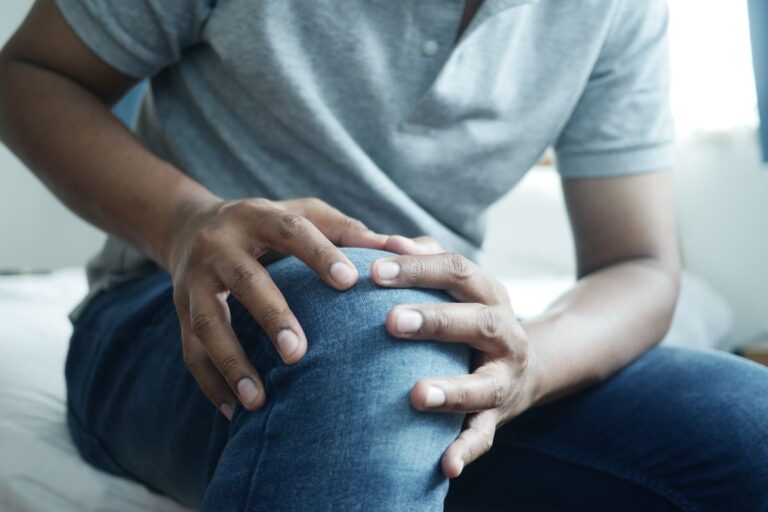
PRP injection knee recovery time is about 3 to 6 months to full benefit, and it unfolds in four phases. Days 1 to 3 are an inflammatory phase when the knee often feels worse rather than better. Weeks 1 to 4 are the proliferative phase, when swelling settles and gradual improvement starts. Weeks 4 to 12 are the remodeling phase, when most patients notice meaningful pain relief, often around weeks 6 to 8. Months 3 to 6 bring the full effect, and improvement can last 12 months or longer. There is no incision and no hospital stay. Most patients walk immediately, drive themselves home the same day, and return to desk work within 1 to 2 days. The main early restrictions are avoiding anti-inflammatory medication such as ibuprofen and staying off high-impact activity.
Want to understand the biology behind these treatments? Read about the science behind regenerative and PRP therapies for joint pain.
Recovery is faster when therapy supports the treatment, as we explain in how physical therapy enhances recovery for joint pain patients.
At Regenerative Joint Clinics in Riverdale, GA, we see patients every week who want to understand exactly what to expect after a PRP injection. Below is the week-by-week timeline, what the research shows, and what changes how fast you recover.
How long should you rest after a PRP injection?
Plan on taking it easy for the first 24 to 48 hours, and resting the knee from heavy use through about day 3. Walking is encouraged right away, and most people return to desk work within 1 to 2 days. Skip running, jumping and heavy squatting for the first few weeks. Use acetaminophen rather than ibuprofen or naproxen for soreness. Follow the instructions your provider gives you at your visit.
What Is PRP and How Does It Work for Knee Pain?
PRP stands for platelet-rich plasma. It’s created by drawing a small sample of your own blood, spinning it in a centrifuge to concentrate the platelets, and injecting that concentrate directly into the damaged knee joint.
Platelets are your body’s natural first responders. They contain growth factors — proteins like PDGF (platelet-derived growth factor) and TGF-β (transforming growth factor beta) — that signal repair cells to rush to the area. When concentrated and delivered precisely into a deteriorating joint, PRP may help support the body’s natural healing process rather than simply masking symptoms. Learn more about how PRP therapy for knee pain stimulates natural tissue repair.
This is fundamentally different from cortisone, which reduces inflammation temporarily but does nothing to address the underlying cartilage damage. It’s also different from hyaluronic acid injections, which lubricate the joint but don’t stimulate biological repair.

How long does PRP knee recovery take, week by week?
PRP recovery doesn’t follow the same pattern as recovering from surgery. There’s no incision, no general anesthesia, and no hospital stay. But your body is doing real biological work, and understanding the timeline helps set realistic expectations.
| Time after injection | What is happening biologically | What most patients feel | What to do |
|---|---|---|---|
| Days 1 to 3 | Acute inflammatory response begins tissue repair | Knee may feel worse: swelling, warmth, stiffness, moderate pain | Rest. Ice 15 to 20 minutes at a time. Avoid ibuprofen and naproxen. Acetaminophen is typically fine. |
| Weeks 1 to 4 | Proliferative phase: growth factors recruit repair cells, new collagen forms | Inflammation settles, gradual improvement begins | Gentle range-of-motion work. Walking encouraged. No running, jumping, or heavy squatting. |
| Weeks 4 to 12 | Remodeling: new tissue matures and organizes | Meaningful pain reduction for most patients, typically around weeks 6 to 8 | Low-impact exercise such as cycling, swimming, or elliptical. Strength and stability work. |
| Months 3 to 6 | Maturation: tissue continues to strengthen | Full benefit realized; many report improvement lasting 12 months or longer | Gradual return to full activity. Continue strengthening. Follow up with your provider. |
Phase 1: Inflammatory Response (Days 1–3)
This is the phase that surprises most patients. After the injection, your knee may feel worse before it feels better. Swelling, warmth, stiffness, and moderate pain are normal — and actually a good sign. The concentrated platelets are triggering an acute inflammatory response, which is the first step in tissue repair.
What to do: Rest the knee. Apply ice for 15–20 minutes at a time. Avoid anti-inflammatory medications like ibuprofen or naproxen — these can interfere with the very inflammatory cascade that PRP is trying to initiate. Acetaminophen (Tylenol) is typically fine for pain management.
Phase 2: Proliferative Phase (Weeks 1–4)
During this phase, the growth factors released by the concentrated platelets are recruiting progenitor cells and fibroblasts to the treatment area. New collagen fibers begin forming. The initial inflammation subsides, and you’ll likely start noticing gradual improvement.
What to do: Begin gentle range-of-motion exercises. Walking is usually encouraged. Avoid high-impact activities — no running, jumping, or heavy squatting. Many patients return to desk work within 1–2 days of the procedure.
Phase 3: Remodeling (Weeks 4–12)
This is where the real structural changes happen. The new tissue matures and organizes. Most patients report meaningful pain reduction somewhere in this window, typically around weeks 6–8. The improvement tends to be gradual rather than sudden.
What to do: Progress to low-impact exercise — cycling, swimming, elliptical training. Physical therapy can be highly valuable during this phase to rebuild strength and stability around the knee.
Phase 4: Maturation (3–6 Months)
Full benefit from PRP often takes 3–6 months to realize. The tissue continues to strengthen and organize. Many patients report sustained improvement that can last 12 months or longer, depending on the severity of the initial condition and adherence to rehabilitation protocols.
What to do: Gradually return to full activity. Continue strengthening exercises. Follow up with your provider to assess progress and determine if additional injections may be beneficial.
Near Riverdale, GA?
We treat knees, shoulders, hips and backs without surgery at one clinic on Upper Riverdale Road. Send the form or call and our team will confirm your visit.
483 Upper Riverdale Road SW, Suite F, Riverdale, GA 30274. Most major insurance and Medicare accepted. PRP is typically elective and not covered by most plans, and our team can walk you through payment plans through Pathways.
How does PRP recovery compare with cortisone, gel injections, and knee replacement?
Understanding PRP injection knee recovery time is easier when you compare it to alternatives:
| Treatment | Recovery Time | Duration of Relief | Addresses Root Cause? |
|---|---|---|---|
| PRP Injection | 3–6 months to full benefit | 12+ months (varies) | May support tissue repair |
| Cortisone Shot | 1–3 days | 6–12 weeks | No — anti-inflammatory only |
| Hyaluronic Acid | 1–2 days | 3–6 months | No — lubrication only |
| Total Knee Replacement | 3 to 6 weeks to resume most daily activities | Over 90% of implants still working at 15 years | Yes — replaces joint |
Total knee replacement figures above are from the American Academy of Orthopaedic Surgeons: most patients resume most normal activities of daily living within 3 to 6 weeks of surgery, and more than 90% of modern total knee replacements are still functioning well 15 years after surgery (AAOS OrthoInfo).
PRP occupies a unique middle ground: it’s minimally invasive like an injection but may help promote biological repair rather than just managing symptoms temporarily. For a side-by-side look at the two options, see our guide to cortisone vs. PRP injections. Gel injections run on a much shorter timeline, and we walk through what recovery looks like after a knee gel injection separately. PRP is rarely used on its own, so it helps to see the full range of non-surgical joint pain treatments we offer in Riverdale before you settle on one.
Cost works differently across these options. PRP is usually a cash service, while other parts of a joint pain plan, such as diagnostics and hyaluronic acid gel injections, are often billable. If you are weighing the price before you book, our guide to how much PRP treatment for the knee costs explains what sets the number and how to get an estimate in writing. Here is how insurance and Medicare work with care at our Riverdale clinic.
Do you need physical therapy after a PRP injection?
Your PRP injection knee recovery time improves measurably when rehabilitation supports the biological healing process.
Clinical research suggests that patients who combine PRP with structured exercise therapy tend to see greater improvements in pain and function than those who rely on the injection alone.
A solid post-PRP rehabilitation program typically includes range-of-motion exercises starting in week 1, isometric quadriceps strengthening by weeks 2–3, progressive resistance training from weeks 4–8, balance and proprioception work from weeks 6–12, and gradual return to sport-specific activities after 12 weeks.
Who Gets the Best Results from PRP?
PRP tends to work best for patients with mild to moderate knee osteoarthritis (Kellgren-Lawrence grades 1–3), chronic tendinopathy such as patellar or quadriceps tendinitis, meniscus tears that aren’t candidates for surgical repair, and patients who want to delay or avoid knee replacement surgery.
Patients with severe bone-on-bone arthritis (KL grade 4), active infections, blood disorders, or those taking blood-thinning medications may not be ideal candidates. A thorough evaluation is essential before proceeding. You can request a knee evaluation in Riverdale, GA to find out which category your knee falls into.
Not sure if PRP is right for your knee?
Our Riverdale, GA team can walk you through which non-surgical option fits your knee. The options are set out on our knee pain treatment in Riverdale, GA page.
Request a Consultation Call (470) 895-0610What does the research say about PRP for knee osteoarthritis?
For authoritative background on the condition PRP is used to manage, the National Institute of Arthritis and Musculoskeletal and Skin Diseases (NIAMS) and MedlinePlus offer patient-friendly overviews of knee osteoarthritis.
The clinical evidence supporting PRP for knee osteoarthritis has grown substantially over the past decade. A 2025 systematic review and meta-analysis in Cureus pooled 6 high-quality randomized controlled trials covering 1,162 patients with mild to moderate knee osteoarthritis. WOMAC pain scores fell by an average of 8.5 points and IKDC function scores rose by 6.2 points, with improvements measured at both 6 and 12 months against control injections.
A separate 2025 meta-analysis in Knee Surgery & Related Research looked specifically at PRP versus gel injections. Across 12 randomized trials and 983 patients, leukocyte-poor PRP outperformed hyaluronic acid on WOMAC total and physical-function scores at 6 and 12 months, and on pain scores at 3, 6, and 12 months.
The evidence is not unanimous, and that is worth knowing before you decide. The same Cureus review notes that one large trial found no significant difference between PRP and placebo in pain scores or MRI cartilage volume at 12 months. Response also varies with disease stage: patients with earlier-stage arthritis (Kellgren-Lawrence grades 1 to 2) tend to respond more robustly than those with advanced, bone-on-bone disease. A proper evaluation of your knee matters more than any single published number.
It’s important to note that PRP preparation methods vary significantly between providers. Factors like platelet concentration, the presence or absence of white blood cells (leukocyte-rich vs. leukocyte-poor PRP), and the number of spins during centrifugation can all influence outcomes. At Regenerative Joint Clinics, we use standardized preparation protocols to help ensure consistent platelet concentration across treatments.
What affects how fast you recover from a PRP knee injection?
Not everyone recovers at the same pace after a PRP knee injection. Several factors can influence how quickly you experience improvement and how significant that improvement will be.
Severity of joint damage: Patients with mild to moderate osteoarthritis (Kellgren-Lawrence grades 1–3) typically respond better and faster than those with severe bone-on-bone arthritis. This is because PRP works by stimulating your body’s repair mechanisms — and there needs to be enough healthy tissue remaining for those mechanisms to work with.
Age and overall health: Younger patients and those in better overall health tend to have more robust healing responses. Platelet function and growth factor production can decline with age, though PRP concentrates enough platelets to partially compensate for this.
Body weight: Excess body weight places additional mechanical stress on the knee joint, which can slow recovery and reduce the longevity of PRP benefits. The effect is measurable: a study of 142 older adults with knee osteoarthritis published in Arthritis & Rheumatism concluded that each pound of weight lost produces a 4-fold reduction in the load on the knee per step. Losing 10 to 15 pounds therefore takes roughly 40 to 60 pounds of force off the joint with every stride.
Activity level and rehabilitation compliance: Patients who follow their post-injection rehabilitation protocol — including physical therapy, progressive strengthening, and activity modification — consistently report better and longer-lasting results. Skipping rehabilitation or returning to high-impact activities too early can compromise the healing process.
Smoking and nutrition: Smoking impairs blood flow and reduces the body’s healing capacity. Nutritional factors, particularly adequate protein intake and vitamin C levels, also play a role in tissue repair. Optimizing these factors before and after your PRP injection can support better recovery outcomes.
How should you prepare for a PRP injection?
What you do before your PRP injection can be just as important as what you do after. These steps can meaningfully shorten your PRP injection knee recovery time and help maximize your results:
Stop anti-inflammatory medications early. Discontinue NSAIDs (ibuprofen, naproxen, aspirin) at least 5–7 days before your injection. These medications suppress the inflammatory response that PRP depends on. Ask your provider about alternatives for pain management during this pre-treatment window.
Stay well-hydrated. Good hydration improves blood draw quality and helps ensure an adequate platelet yield during the centrifugation process. Aim for at least 64 ounces of water in the 24 hours before your appointment.
Eat a protein-rich meal. Your platelets need raw materials to produce growth factors. A balanced meal with adequate protein 2–3 hours before your appointment supports optimal platelet function.
Arrange transportation if needed. While most patients can drive themselves home, some prefer to have someone available, especially for a first injection when they’re unsure how they’ll feel afterward.
When you are ready to put a date on the calendar, you can book a consultation at our Riverdale clinic.
Frequently Asked Questions About PRP Knee Recovery
Take the Next Step Toward Knee Pain Relief
Now that you understand your PRP injection knee recovery time week by week, you can plan the next step with confidence. If you’re tired of temporary fixes and want to explore whether PRP therapy could help support your knee’s natural healing capacity, Regenerative Joint Clinics offers comprehensive evaluations and personalized treatment plans for knee osteoarthritis and joint pain. Explore our dedicated PRP therapy for joint pain in Riverdale, or see how PRP knee therapy in Riverdale may help when other treatments haven’t worked.
Schedule your consultation today to discuss whether PRP is right for you.
Regenerative Joint Clinics
483 Upper Riverdale Rd SW, Suite F, Riverdale, GA 30274
Phone: (470) 895-0610
Email: contact@regenerativejointclinics.com
Related reading: Rediscover Life Without Joint Pain — see how the non-surgical Targeted Restoration Protocol combines diagnostics, injections, custom bracing, and physical therapy (by referral) to address the root cause of joint pain.
Disclaimer: This article is for informational purposes only and does not constitute medical advice. Consult your healthcare provider before starting any new treatment. Individual results may vary.
Related guide: PRP Injection Cost: 7 Key Factors That Determine What You Pay
If you are a Riverdale resident coping with ongoing knee pain, see our local guide to living with knee pain in Riverdale.
Ready to talk about your knee pain?
Our team in Riverdale, GA can help you understand whether PRP, gel injections, or another non-surgical option fits your situation.
Request a Consultation Call (470) 895-0610Take the 60 second joint pain quiz. You will get a personalized assessment based on your answers, and our team will follow up with next steps.
Start the quiz